
Or What We Learned from Switzerland’s Cooperative Housing Ecosystem & Vice Versa
For the week surrounding this year’s International Day of Cooperatives, we went to Switzerland to deepen relationships with those that have spent decades in the guts of one of the world’s strongest cooperative housing ecosystems. The exchanges were focused on coop housing ecosystem building, collaborative housing finance and international cooperative solidarity.
We spent the week visiting Geneva’s housing cooperatives and meeting its residents – including CODHA, Archipel, Équilibre and SCHG. We learned of the different ways they use external and internal capital to develop new projects and support members, of how their origins, scale and residents affect their priorities. We also met with Philea, a non-profit coop that facilitates access to credit. In Zurich, we met Hans Rupp (former ABZ and Kraftwerk1 CEO), Andreas Wirz (WBG Zurich), and Franz Horvath (WBG Swizerland) to use our collective intelligence to pinpoint what makes coop housing in Switzerland work as a fundamental part of the housing system – and to identify new ways of moving forward with building a new reality for cooperative housing in Central and South-Eastern Europe.
Strengthening Each Other
urbaMonde – a wonderful ally to MOBA and many worldwide who organise for and around community-led housing – helped us organise the visit, with Léa from urbaMonde hosting uur Ana, Marc, Zsuzsanna and Adel, joined also by Giulia from the European Alliance for Collaborative Housing (EACH) and Dali from Community Land Trust Brussels.
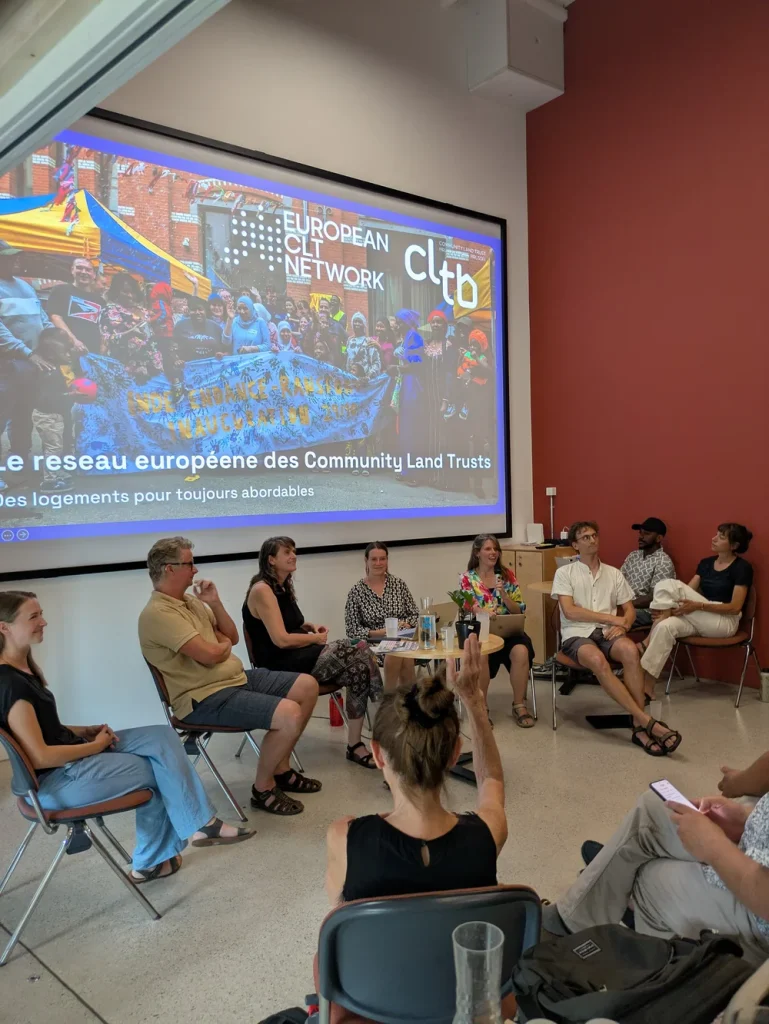
Beyond the site visits, we focused on strengthening the relationships within the European Alliance for Collaborative Housing, coordinated by the European Community Land Trust Network (ECLTN). Together we presented our permanently affordable, non-speculative models at a roundtable on our solutions and financing, co-organised by urbaMonde and APRÈS-GE.
Read more about the Alliance’s work and the reflections on the week from urbaMonde and ECLTN. Our own reflections continue below:


Institutions Don’t Appear Overnight – The Importance of Timing
While Swiss cooperatives benefit from decades of widely accumulated knowledge, supportive public policies and dedicated financial instruments, initiatives in our region are still reimagining and reintroducing traditions that were interrupted for generations. These discussions also came at an important political moment. With the European Alliance for Collaborative Housing, MOBA is working for substantial support for collaborative housing (coops and community land trusts) to be included in the European Affordable Housing Act – and for this to be complemented by a dedicated funding stream in the accompanying investment platform. First-hand testimonies on the histories and current practices of operating within a context with a rich cooperative tradition, as well as reactions to our presentations at the roundtable sharpened the Alliance’s advocacy angles.


And yet, part of our regional reality is that we cannot afford to wait for decision-makers to put supportive mechanisms into place. The dire need for diversifying forms of (affordable) housing, disproportionally affecting our semi-peripheral region, is prompting more people to organise for community-led housing. There is no shortage of people willing to create cooperative housing – what is missing are the institutions. And so, their labour is doubled by the need to build up the whole infrastructure in parallel to building projects in precarious conditions.
This is why MOBA as a European Cooperative Society was formed in the first place – the form makes it legally possible to build our own translocal financial infrastructure with the Accelerator and support initiatives in their most vulnerable stages. The importance of this was recently exemplified in practice when the student group organised around TEK in Budapest used a MOBA Accelerator loan to pay the deposit for a new building after being forced out of their privatised student dormitory. This also marked the piloting of the Accelerator after previous testing. Fundraising for the project continues, and MOBA is building up towards the foundational layer of €1 million from donations in order to support additional groups with a timely bridge loan, help house communities in need and strengthen the movement.

Solidarity as Infrastructure – Extending the Coop Tradition
Conversations about MOBA’s Accelerator led to figuring out how established cooperative ecosystems can stand in solidarity with emerging ones and use the Accelerator as a channel for this solidarity too. Fundamentally, we went back to basics in our collective thinking – cooperativism works because it is built upon the pooling of resources – and their distribution according to long-term benefits for communities and localities.
Over the coming months, we will continue these conversations with housing cooperatives and umbrella organisations in Geneva, Zurich and beyond, working towards solidarity-based contributions that can help build the first €1 million foundation layer of the MOBA Accelerator and, in the next phase, broaden cooperative contributions through shares. Before this visit, we often felt that the Swiss experience wasn’t particularly relevant for us as its reality is simply too far removed from ours. However, we return from Switzerland inspired by the openness of our hosts, having found people who are willing to help us build the institutions that are missing in our region by extending a cooperative tradition of mutual aid across borders.


