
Regional Housing Forum, that took place on 10th and 11th of May 2022 and was organized by Association for Democratic Prosperity – ADP Zid, was an opportunity for us to present our Moba Accelerator, a unique financial instrument, created in order to give support to pioneering housing cooperative initiatives in this region.
Continue reading “Regional Housing Forum in Podgorica”Czech non-speculative housing network Sdílené domy bought their first house
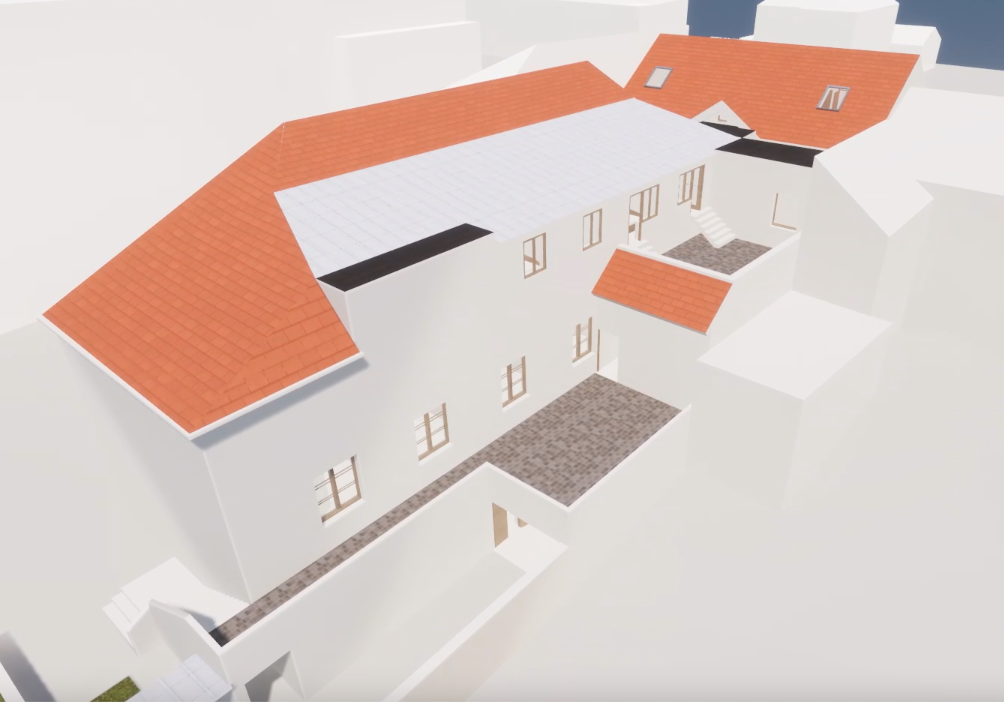
After several years of preparations, the collective Sdílené domy (Shared Houses) bought its first housing project in Prague, Czech Republic! As the name of the project První vlaštovka (First Swallow) says, they hope it will be the first piece of a broader network of housing projects in the Czech Republic, similar to Mietshäuser Syndikat in Germany or HabiTAT in Austria. Furthermore, they hope to set a working example that could help not just other projects in the Czech Republic but also other countries of Central and South-Eastern Europe through the MOBA Housing network.
Here Sdílené domy report on the last months of their endeavour.
Experiences in Supporting Co-operative Housing Development in Central and South-Eastern Europe
By Ana Džokić and Rok Ramšak, following the piloting year of the MOBA-World Habitat Co-operative Housing Development Grant. Ana and Rok are from emerging housing initiatives in Belgrade and Ljubljana – part of MOBA Housing SCE (MOBA) – a network of pioneering co-operative housing projects from Central and South-Eastern Europe. Together, they developed a shared model for affordable, sustainable and non-speculative housing – along with the tools to turn this ambition into a reality.
Originally published at the World Habitat blog.
Due to the widespread lack of affordable and secure housing in the Central and South-Eastern European region, MOBA Housing SCE emerged in 2017 to foster collaboration around strategies for cooperative housing development.
World Habitat has partnered with MOBA from the start as part of their Global Community-led Housing programme, including in the joint development of the MOBA-World Habitat Co-operative Housing Development Grant. This initiative specifically focused on advancing the housing co-operative approach in this region of Europe. In its first pilot, during 2020-2021, the £15000 Grant supported five proposed local projects that used a series of very different approaches to work towards community-led and affordable housing development. Let’s see how that worked out in five different contexts.
Belgrade, Serbia – Pametnija Zgrada Cooperative
Under Serbian legislation, housing co-operatives cannot lease privately owned land, and public land is currently not available for citizens-led initiatives. Therefore, for Pametnija Zgrada Cooperative, land acquisition became a prerequisite to make a partial equity rental co-operative housing model feasible in the local context. The grant enabled the shortlisting of possible locations that fit the criteria, as well as a financing plan for the land purchase. The land search brought crucial hands-on insights on how to undertake the search and evaluation process, how to establish what constitutes an adequate location, and what’s available and its pricing in the current market. As a result, they have managed to identify several potential plots and have pre-booked one specific site for a pilot project.
Budapest, Hungary – Rákóczi Collective
Despite Hungary’s lack of legal, institutional, and financial infrastructures for rental housing co-operatives, members of Rákóczi Collective already managed to purchase the first house for this purpose in 2018. In 2021, the grant helped create two legal entities: an umbrella organisation for rental housing co-operatives (which also has a development role for new housing projects) and an association to recruit new members into the co-operative housing movement, with particular focus on the next upcoming co-operative house. Forty new potential members have been recruited, helping refine the financial model of the housing co-operative.
Ljubljana, Slovenia – Zadrugator Cooperative
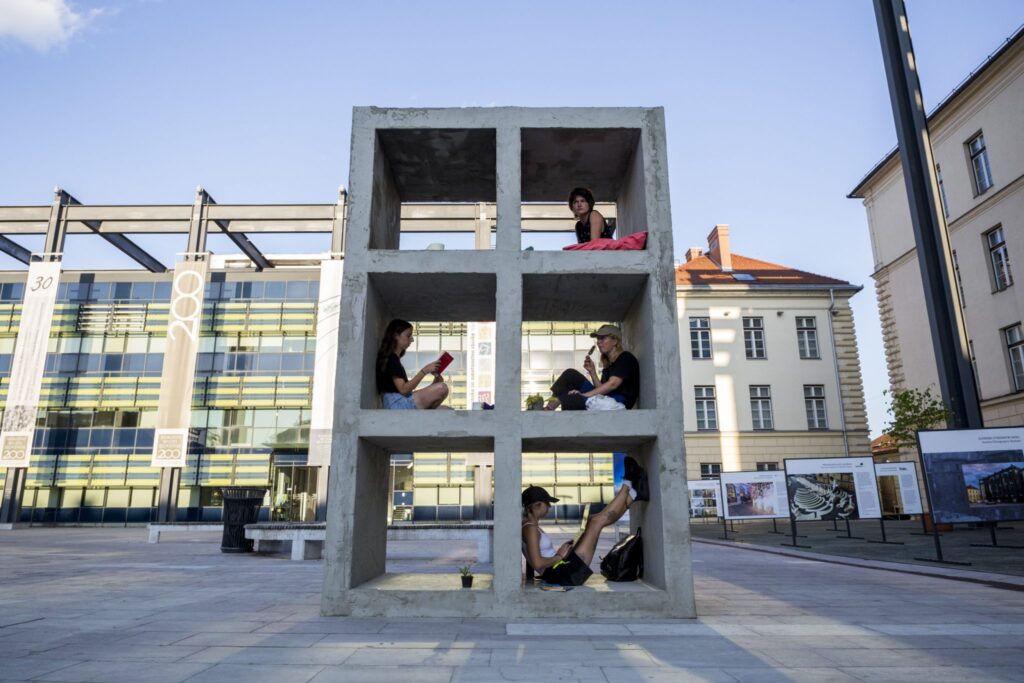
With the change in the political landscape in Slovenia, the pilot housing co-operative project had come to a stalemate as the newly appointed government scrapped the new housing law required for housing co-operatives to be viable. Zadrugator Cooperative responded by using the grant to put a significant effort into promoting and advocating co-operative housing on national and local levels through an awareness and advocacy campaign. As a culmination of their activities, they have installed a Monument to the Housing Crisis in co-operation with an artistic collective “m2” in the centre of Ljubljana and managed to include housing co-operatives in an intervention law on public housing provision put forward to the National Assembly.
Prague, Czechia – První Vlaštovka Cooperative
První Vlaštovka used the grant to engage external experts to help develop a detailed professional business plan to approach private financial institutions to finance the purchase and renovation of the property. The business plan is adaptable and should serve as a basis for other similar groups to use within Czechia, under the umbrella initiative Sdílené Domy. Thanks to securing commitment for co-financing, they went on to successfully purchase the first property that will be transformed into a housing co-operative and a social centre based on the co-operative rental model.
Zagreb, Croatia – Zadruga Otvorena Arhitektura/ZOA
Currently, no laws and financial instruments support the establishment of housing co-operatives in Croatia. To bridge the gap, Zadruga Otvorena Arhitektura/ZOA decided to use the grant to involve legal, real estate and construction experts in creating a step-by-step strategy for local governments to kick-start the development of a co-operative housing model. To get a step closer to proposing the model to the city of Zagreb, ZOA mapped out city-owned plots of land suitable for the construction of co-operative housing and developed three conceptual architectural projects and related financial models.
As well as supporting local projects, the grant has increased the network’s capacity to support its members. In fact, funding was provided from World Habitat to MOBA, who created a collaborative grant-making system for its membership to channel tailored financial support for local projects. This came with a package of support with discussions on how to improve proposed projects, channels for feedback and peer-to-peer exchange on progress and achievements. In the words of Rok Ramšak from Zadrugator: ‘Let me tell you what I love about MOBA’s grant system: the groups don’t compete for funding, they help each other improve and deliver each project’.
Given the success of these first experiences, a second round of the MOBA-World Habitat Co-operative Housing Development Grant was launched in late 2021 with approximately £20000 to advance on aspects such as membership engagement and training, researching technological and sustainable solutions, and policy development. The grant management system will also be improved with the aim to grow and support more pioneering community-led housing initiatives in Central, Eastern and South-Eastern Europe – where sustainable and affordable solutions are greatly needed.
To hear more about how you can connect with or support MOBA Housing SCE, please email: info@moba.coop
Can catalytic capital break the financial deadlock of affordable housing in Central and Southeastern Europe?
MOBA is glad to announce that it is part of a consortium of organisations that looks at the potential of catalytic capital (investment capital that is patient, risk-tolerant, and rather flexible) to kick-start affordable housing.

At focus is the housing sector in Eastern and South-Eastern Europe (ESEE), where for many years, housing has become increasingly unaffordable to a significant part of the population. In parallel, there is an increasing need for investment in sustainable housing solutions to address the climate crisis. Due to a lack of systematic public engagement in ESEE, the development of innovative housing solutions strongly relies on independent housing organisations. These organisations face important difficulties in accessing finance, mainly due to the risk-aversion of existing housing finance institutions in the region.
The Catalytic Capital Consortium’s (C3) Grantmaking program – housed at and administered the New Venture Fund (NVF) now has provided the support to take a deeper look into the potential of catalytic investments in this field. In total, C3 has awarded 14 research proposals from universities, nonprofits and collaborations spanning seven countries. The aim of C3 is thus to enable social and environmental progress that would not otherwise be possible.
The research MOBA now participates in looks at both EU and non-EU countries – 8 countries altogether, with 4 selected as core research countries, including Croatia, Hungary, Serbia, and Slovenia. Access to innovative forms of housing finance is quasi nonexistent in all target countries. We firmly believe that if patient or catalytic capital were to systematically endow the housing sector of the region, then this would allow new, innovative housing providers to consolidate their activities, meaning that the sector of permanently affordable housing – ranging from limited equity cooperative housing to more conventional forms of rental housing – can finally come to life and expand in this part of Europe. This, in turn, would mean access to housing for social groups currently excluded from the housing market. In the research we will uncover the characteristics of both the demand-side and the supply-side of this sector and will also identify the bottlenecks that need to be overcome for the two sides to meet.
Consortium members:
Periféria Policy and Research Center
Budapest, Hungary
https://www.periferiacenter.com/
IŠSP – Institute for Studies of Housing and Space (Inštitut za Študije Stanovanj in prostora),
Ljubljana, Slovenia
http://zadrugator.org/issp/
Who Builds the City (Ko gradi grad),
Belgrade, Serbia
https://www.kogradigrad.org/
Right to the City (Pravo na grad),
Zagreb, Croatia
https://pravonagrad.org
Nadácia Habitat for Humanity International, Slovakia
– office of HFHI Europe, Middle East and Africa
https://www.habitat.org/
ZEF – Cooperative for Ethical finance (Zaduga za etično financiranje),
Zagreb, Croatia
https://zef.hr/en
MOBA Housing SCE
https://moba.coop/
The 2nd Call for the MOBA World Habitat Grant is out!
With the support of World Habitat, MOBA successfully developed and launched the MWH Grant in 2021. By providing access to non-refundable funding, the Grant supports advancing the novel housing cooperative approach in Central and South-Eastern Europe.
The 2022 Call provides 20.000 EUR to support a maximum of five projects by MOBA full members. Each organisation may apply for funding within the scope of 2.000 to 4.000 EUR. Exceptionally, applicants may apply for a higher funding volume (up to 8.000 EUR) if they can clearly show a direct and significant impact on the project outputs.
The MWH Grant aims to support and empower pioneering cooperative housing initiatives by improving access to:
1. Knowledge
- Providing education and know-how around cooperative housing to project leaders, future residents or other relevant stakeholders (funders, local partners, etc.) to ensure the advancement of a cooperative housing project
- Developing tools that enable the establishment or furthering of cooperative housing
- Strengthening international cooperation and solidarity to build up the knowledge for country projects
2. Land
- Securing and or purchasing a piece of land (or working towards this)
- Securing a partnership that can enable access to land or funding
3. Finance
- Developing and implementing financial strategies
- Securing a partnership that can enable access to real estate or financing
4. Policy and Legal matters
- Developing policy or legal processes relating to cooperative housing
- Advocating and securing the adoption of policy or legal processes relating to cooperative housing
5. Technical and Environmental matters
- Advancing on design and technical features for housing development
- Developing sustainable low-carbon housing development solutions
More information is available in the MOBA-World Habitat Cooperative Housing Development Grant – 2022 Call for Projects.
Proposals are due by February 15, 2022.
CooP conversations: episode MOBA SCE

In the latest #CoopConversations episode Cooperative Housing International is in conversation with Ana Džokić, an #architect with over 20 years of experience pioneering unconventional approaches to the challenges of contemporary urban development and member of the management board of MOBA Housing. Ana is also a founding member of two civil associations that deal with the unsustainability of the current housing condition. In Belgrade, Ko Gradi Grad is setting up a new breed of non-speculative housing cooperatives; in Rotterdam, Stad in de Maak manages “toxic assets” of stranded Dutch welfare housing. She is the founding director of Pametnija Zgrada, the first housing co-operative established in Belgrade in the last 20 years. She is also one of the founders of the energy #cooperative Elektropionir in Belgrade, Serbia, a pioneer in small-scale solar in Serbia.
Listen to the full episode here.
MOBA Housing Development Fund – Launch
The first Call for Loan Requests of the MOBA Housing Development Fund
MOBA Housing SCE is calling its full member organisations to submit proposals for projects to be financed with the support of its MOBA Housing Development Fund.
The link to the Call for Loan Requests form can be found here. Proposals will be received until June 20, 2021, and reviewed by the Fund Committee. Decisions about the attribution of funds will be taken by June 30 and loans will be issued in July. A further Call for Loan Requests may be issued later in the year.
What is the MOBA Housing Development Fund?
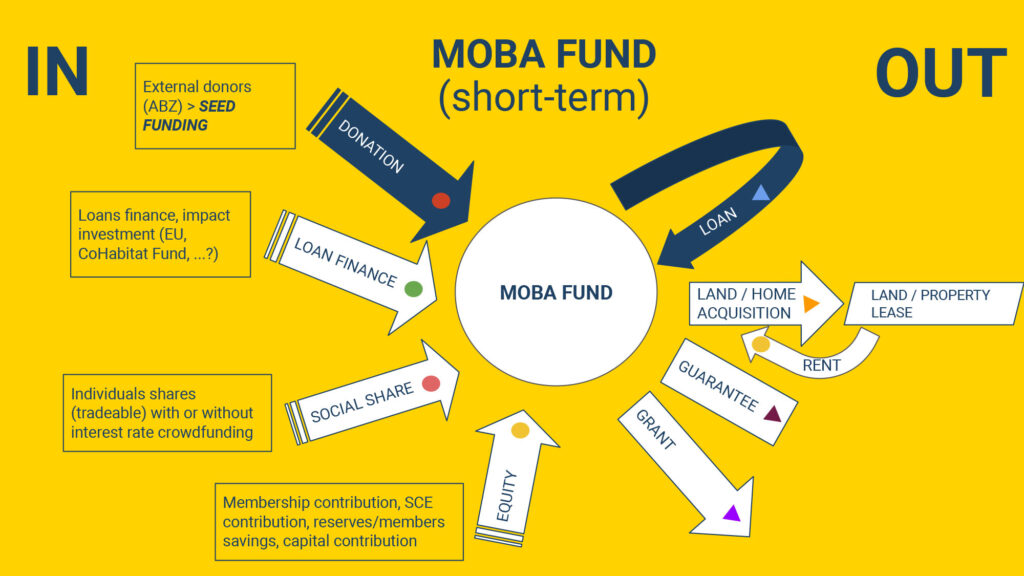
The MOBA Housing Development Fund is being set up as part of the MOBA Housing SCE and thanks to a seed capital of 21,600 EUR provided by the cooperative ABZ in Zurich. Currently, in its pilot stage, it is intended to grow into the financial vehicle of MOBA, supporting the development of cooperative housing projects federated under MOBA.
Who is the Fund Committee?
The Fund Committee is composed of 1 representative of each MOBA (full) member – plus 1 representative of an associate member nominated to the Fund Committee as a facilitator (with no right to vote). The member(s) who submit an application cannot vote on their own proposal.
The Fund Committee is being constituted in parallel to the present Call for Loan Requests and approved by MOBA Housing SCE’s General Assembly (in mid-June 2021).
The Fund Committee is responsible for issuing the Call for Loan Requests (except for this first Call which is issued by the working group) and responsible for taking decisions on loan allocation and repayment conditions.
How does it work?
The present Call for Projects is a “test run” for the MOBA Housing Development Fund. In 2021, the MOBA Housing Development Fund will issue at least one loan to MOBA members with the aim of attributing the total amount of 18,000 EUR to its members in the course of 2021.
Types of loans, among others:
- Kick-start loan/door-opener for other financiers
- Bridge loan
- Renovation costs
- Land or house acquisition
The loan cannot be used to pay consultants, studies or human resources.
Eligibility criteria:
- To request a loan, one must be a full member of MOBA Housing SCE.
- The repayment capacity/financial solidity/risk will be assessed on the basis of the financial plan of the project.
- Priority will be given to projects with urgent financial needs and that have a high impact on the project lifecycle.
The definite criteria will be discussed and established by the Fund Committee.
Terms:
- The loans should have a duration of a maximum of 18 months
- The maximum amount you can request in this round is 18,000 euros. The Fund Committee may suggest reviewing the loan duration and amount.
- The loan is issued in euros; transfer costs and the currency exchange risk will be covered by the Fund’s reserve. To cover for the risk, the MOBA Housing Development Fund will keep a reserve of an additional 20% (3,600 EUR).
- The suggested repayment schedule is every 6 months via bank transfer, but members can propose a repayment schedule that better fits their project.
- The yearly (nominal) interest rate is 2.5% (interest on a 1,000 EUR loan = 25 euros per year).
A loan contract will be signed between MOBA Housing SCE and the MOBA member (applicant), in line with Croatian legislation.
Webinar: MOBA – building finance for cooperative housing in Central and South-Eastern Europe
One of the main obstacles facing community-led cooperative housing in Hungary, and more broadly in Central and Southeastern Europe (CSEE), is the difficulty to access affordable housing finance. In search of quick and high returns, investment in the CSEE region flows almost uniquely into market-based models of housing. These models promote home-ownership and are not accessible to many households without significant capital to buy an apartment or equity to acquire a mortgage.
In 2017 pioneering housing cooperatives from CSEE joined forces and founded the MOBA Housing Network (since 2020 European Cooperative Society, SCE). One of the main aims of MOBA is to build an infrastructure for accessing large-scale investment for the cooperative housing sector. Such investments could kick-start community-led housing projects, and lead to more affordable housing.
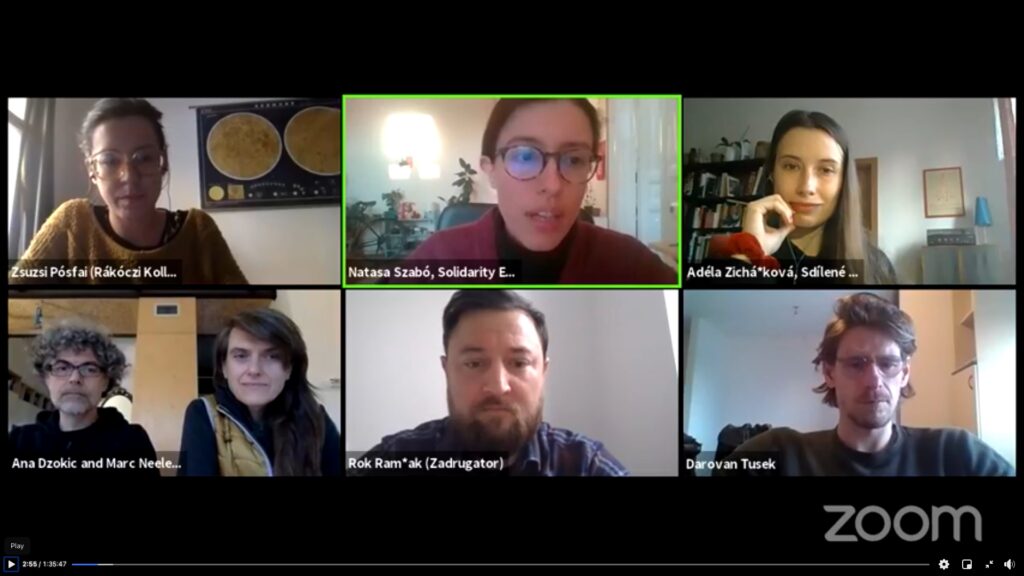
This webinar held on 10 March 2021, presented the work of the MOBA Housing SCE and the cooperative housing projects of MOBA members from Belgrade, Budapest, Ljubljana, Prague and Zagreb.
It addressed the following questions: What is the state of cooperative housing in each of the member countries? What are the main obstacles to financing cooperative housing in CSEE? What kind of bottom-up financial solutions is MOBA developing to address the situation?
Particpants: Zsuzsi Pósfai (Rákóczi Collective, Budapest), Ana Džokić and Marc Neelen (Ko gradi grad/Pametnija Zgrada, Belgrade), Rok Ramšak (Zadrugator, Ljubljana), Darovan Tušek (Zadruga Otvorena Arhitektura, Zagreb), Adéla Zicháčková (Sdílené domy, Prague). Moderator: Natasa Szabó (Solidarity Economy Center, Budapest).
The webinar has been organised by the Solidarity Economy Center and Fordulat Magazine, Budapest. Funded by the European Cultural Fund’s Culture of Solidarity program.
For summary of the webinar in Hungarian see the article Felválthatja a profitelvet a kölcsönös segítség a lakhatásban? Lakásszövetkezetek Kelet-Európában.
Ljubljana: our determination… to make community-led housing a reality
Text by Anja Lazar & Rok Ramšak, originally posted by World Habitat
Anja Lazar and Rok Ramšak are members of Zadrugator, a housing co-operative in Ljubljana, Slovenia. Zadrugator is one of the pioneering co-operatives working together with others across Central and South-Eastern Europe as part of MOBA Housing SCE.
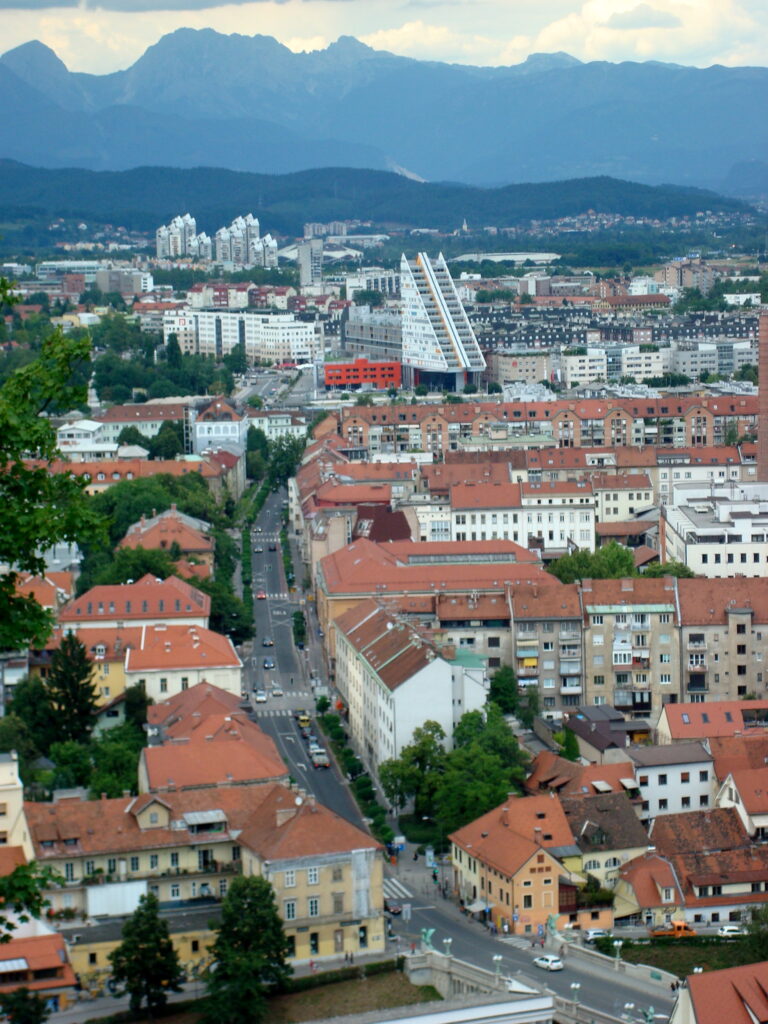
In most European cities, housing is becoming an increasingly big issue. The situation is especially alarming when it comes to affordable housing.
In Slovenia it is no different. With housing provision being almost exclusively in the domain of the free market, Slovenia has one of the highest proportions of housing that is not suitable for living – one-in-three (33%). And almost a third (30%) of families live in housing poverty. It’s becoming increasingly difficult for young people to gain independence with almost two in every three (64%) young adults between 18 and 34 still living with their parents – nearly double the European average!
This comes as no surprise due to the fact that Slovenia spends 10 times less on housing than an average European state, and a whopping 100 times less on housing construction. In fact, the state’s contribution to the construction of public housing has remained at a very stable zero for the last 10 years.
But how does this impact people’s everyday lives?
In the past years we have been discussing the housing crisis with students, people looking for their first apartment, young families and elderly people, who are struggling to find adequate housing in Ljubljana. We are summarising their stories using a fictional person who we have named Tina.
Tina is 34 years old and works in Ljubljana. She grew up in a smaller town but moved to study and has stayed there because it is one of the few places where it is possible to get a job. She applied for a student dorm, but even though her family is well below the median income, she was told that she’d need to wait at least half a year to move in because there are simply not enough. And because of poor public transport, the only option was a private apartment rented with three friends. Despite sharing a room, she worked around 20 hours per week and had to use her entire scholarship to cover the rent and living expenses.
In the last 10 years, she has moved at least six times. The owners would increase the rent or decide to start renting out through AirBnB. But she was quite lucky – she always found good flatmates and for the past five years, since working full-time, she has even been able to afford her own room.
Tina is earning the average Slovenian wage and is among the 30% of highest earners. But she is still spending over a third (nearly 35%) of her income on a small room in an apartment she shares with three other people. Lately, she finally started exploring other options.
After several months, she was not able to find an affordable apartment to rent on her own. The cost of an average sized single room apartment would be somewhere between €500 and €600 – this would be well over half (around 60%) of her income spent on housing costs.
Buying a home would be impossible. With only new luxury projects being built, the prices are so high that even if she could find a good deal for the apartment and a low interest rate for the loan, she would have to spend close to 70% of her income. And even if she dreams of a big promotion and a higher wage, she would simply not be able to save up enough to put down a deposit of at least €25,000.
She considered non-profit rental apartments, provided by national and municipal housing funds. But realised that for each apartment, there are dozens of families in need. Such a discrepancy in fact, that some funds started organising lotteries for applicants.
So, what is the alternative?
Unfortunately, there are no other existing alternatives in Slovenia, resulting in a lot of young people moving abroad or forced to live in apartments, and even more often, in single rooms that do not allow them a decent quality of life.
That is why, four years ago, we established Zadrugator, a housing co-operative. We want to address the lack and inaccessibility of decent housing and have always advocated for not-for-profit public housing provision. But as this requires, above all, significant political will, we have started looking for other, more community-based, grassroots alternatives.
Going through countless examples of housing mechanisms from around the world, we came to realise that not-for-profit rental housing co-operatives are our best bet.
Zadrugator based its model on successful co-operatives in Switzerland – namely More than Housing in Zurich, which we visited on a World Habitat peer exchange in 2017. They inspired us because of their accessibility to different social groups, high standards of living, and a high-level of resident and local community participation.
The Zadrugator model is truly a co-operative model, based on a joint investment by the members, the provision of the land by the municipality, a loan from the national housing fund and resources from external lenders or investors.
The future residents are members of the co-operative, owning shares and having full voting rights – but they won’t own their apartments. Instead, they will rent the apartments from the co-operative for a not-for-profit rent. Because of the very poorly developed housing sector in Slovenia, we estimate that the rent will be at least 20-30% lower than the market rent – and as market rents will surely rise in the future, the co-operative rent will stay the same.
We have made significant progress in developing the first pilot project. We are collaborating with Ljubljana’s local authorities, who are willing to host the co-operative housing development on public land, and advanced on finding funding possibilities. With the support of World Habitat, we have also developed the architectural design for the pilot project.
However, we are also facing many challenges in our hopes to start a strong and viable co-operative movement here in Slovenia. Our main issue is that housing co-operatives are not yet included in Slovenian housing law, which prevents us from working with public partners in a meaningful way and significantly inhibits our possibilities of providing affordable rent. But that is not denting our determination or our commitment to advocate for this to change, and to make community-led housing a reality. This will make good homes more affordable for ‘Tina’ and the countless others like her.
Image: Bryce Edwards (Creative Commons)
Webinar: Cooperative Housing Development – Thinking Outside the Box!
Co-operative Housing International and urbaMonde, two partners in the CoHabitat Network organised the webinar “Cooperative Housing Development – Thinking Outside the Box!”, involving Zsuzsi Pósfai – MOBA (Hungary), Bea Varnai – urbaMonde (France), Lea Oswald – urbaMonde (Switzerland), Hans Rupp – ABZ (Switzerland) and Gauthier Guerin – Radical Routes (UK). Take a look!
“Different groups around the world are using innovative financing tools to raise capital for their cooperative housing initiatives. However, they didn’t come by these ideas alone. By forming regional networks, collaborating, and networking they were able to pool their thoughts together to come up with innovative ideas, allowing them to move forward. This webinar is a conversation with cooperators and project managers developing cooperative and community-led housing in Europe and beyond. They will share their experiences and knowledge related to innovative financing models, the benefits of creating a regional network, and the challenges of developing a housing cooperative based on collective ownership in Central and Eastern Europe.”